
Molecule Library
GLOW Peptide: What the Blend Contains, Possible Benefits and Side Effects
Helpful information about the ingredients commonly associated with GLOW, possible benefits, side effects, GLOW vs. KLOW, human research and product-quality questions.
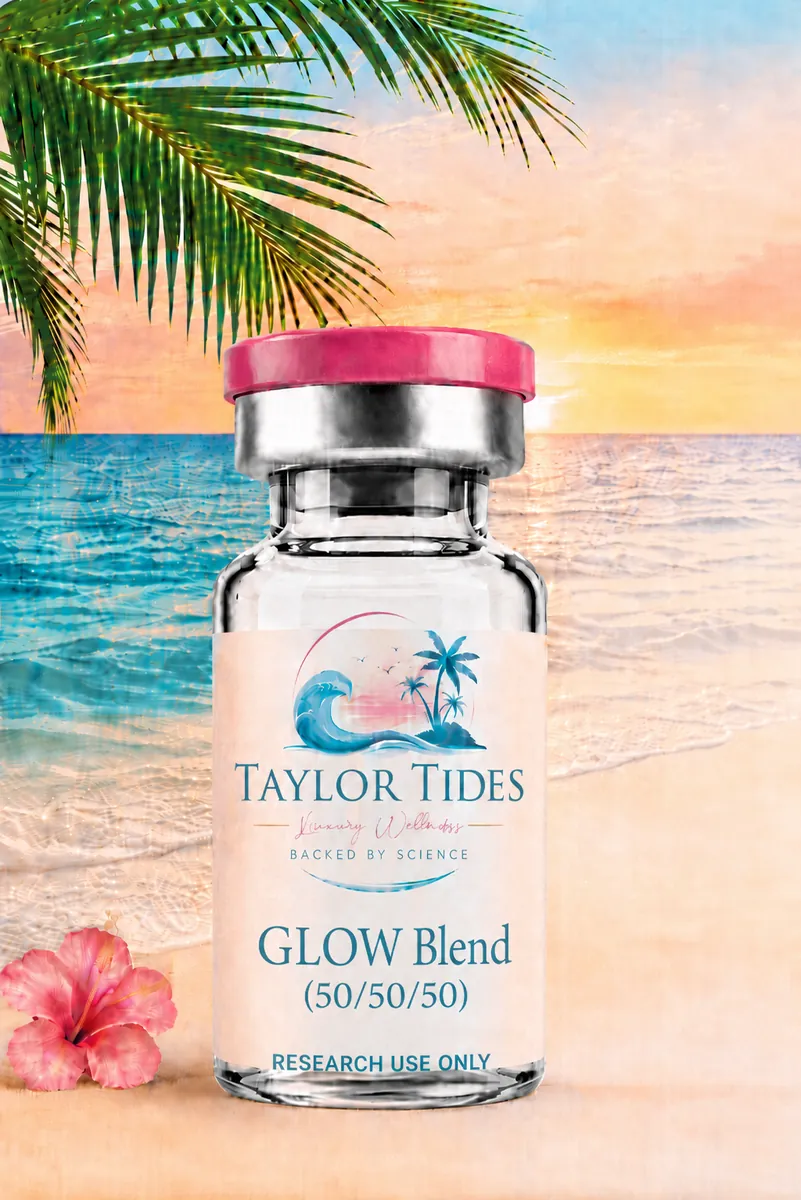
The GLOW peptide is not one peptide. It is a product name commonly used for a blend of GHK-Cu, BPC-157 and TB-500.
People research GLOW for possible connections to skin appearance, hair, injury recovery and tissue repair. That interest comes from studies of the separate ingredients. It does not demonstrate that combining the three compounds produces the same effects in people.
We found no controlled human trial studying the complete GLOW blend. The name and formula are not standardized, so ingredients and amounts may vary between suppliers.
GLOW Peptide in 30 Seconds
- GLOW commonly combines GHK-Cu, BPC-157 and TB-500.
- It is a supplier-created blend, not one naturally occurring peptide.
- GHK-Cu is connected to skin, hair, collagen and tissue research.
- BPC-157 and TB-500 are connected to tissue-repair and recovery research.
- Studies of the separate ingredients do not establish that the complete blend is effective or safe.
- Most BPC-157 and TB-500 evidence comes from laboratory or animal studies.
- Human GHK-Cu research has focused mainly on products applied to the skin, not an injectable blend.
- Formula, product quality and independent testing matter because GLOW products can vary.
What Is the GLOW Peptide Blend?
A blend means several different compounds have been placed in the same vial.
GLOW commonly refers to:
- GHK-Cu: A short peptide that carries a copper atom. It is studied in connection with skin, collagen, hair and tissue repair.
- BPC-157: A laboratory-made peptide studied mainly in animals for possible effects involving injured tissue, tendons, muscles and the digestive system.
- TB-500: A manufactured fragment based on part of a larger natural protein called thymosin beta-4. It is studied for possible roles involving cell movement and tissue repair.
Combining these ingredients creates a mixture, not a new molecule.
“GLOW” is a supplier-created name, not a scientific definition. The name alone does not confirm what a vial contains. Research on one ingredient also cannot establish what the complete blend will do.
Why Do People Research GLOW?
Interest in GLOW usually begins with skin, hair or physical recovery.
GHK-Cu is the component associated with skin and hair. BPC-157 and TB-500 are the components associated with recovery. Sellers often present these research areas as though the ingredients have been proven to work together. That has not been established in people.
GLOW is frequently discussed in connection with:
- Collagen and skin appearance
- Fine lines and wrinkles
- Hair growth or reduced shedding
- Tendon, ligament and muscle injuries
- Recovery after exercise
- Joint discomfort
- Wound healing
- Digestive concerns
- Inflammation
Some of these subjects have been studied for an individual ingredient. Others come mainly from supplier claims, social-media discussions or personal experiences.
GLOW should not be confused with a weight-loss peptide. Its usual ingredients do not work like semaglutide, tirzepatide or retatrutide.
What Has Actually Been Studied?
The most important research distinction is simple:
Scientists have studied the ingredients separately. They have not demonstrated that the complete GLOW blend produces its claimed results.
GHK-Cu Research
GHK-Cu is a small copper-carrying peptide. Copper participates in body processes that include collagen formation and tissue maintenance.
Some human research has evaluated topical GHK-Cu products. Topical means the product was applied to the skin.
One small study examined GHK-Cu skincare after laser resurfacing. Researchers found no significant objective improvement in redness, wrinkles or overall skin quality compared with another skincare routine. Participants using GHK-Cu did report greater satisfaction with their skin.
Applying GHK-Cu to the skin is not the same as injecting it. A topical study cannot establish the benefits or risks of an injectable GLOW blend.
BPC-157 Research
BPC-157 is a laboratory-made chain of 15 amino acids. Amino acids are small pieces the body uses to build peptides and proteins.
BPC-157 has been studied for possible effects involving tendons, ligaments, muscles, bones, digestive tissue and inflammation.
Most encouraging findings come from cell and animal studies. Human evidence remains very limited, and a complete safety profile in people has not been established.
TB-500 Research
TB-500 is a manufactured peptide fragment. A fragment is a smaller piece based on part of a larger natural protein.
The full protein, called thymosin beta-4, has been studied for possible roles involving cell movement, blood-vessel formation and tissue repair.
TB-500 and full-length thymosin beta-4 are related, but they are not interchangeable. Research on the full protein does not demonstrate that the shorter TB-500 fragment produces the same result.
Has the Complete GLOW Blend Been Studied?
We found no controlled human trial studying the commonly marketed combination of GHK-Cu, BPC-157 and TB-500.
This leaves important questions unanswered:
- Does combining the ingredients change how they behave?
- Do different ratios produce different effects or risks?
- Does injectable GLOW improve skin, hair or injury recovery?
- How often do side effects occur?
- What happens with repeated use?
- If something happens, which ingredient caused it?
A study involving one ingredient cannot be multiplied by three to establish that the blend is effective.
The idea may sound logical: combine one compound connected to skin research with two compounds connected to recovery research. That is a research theory, not evidence that the blend works in people.
GLOW vs. KLOW: What Is the Difference?
GLOW and KLOW are supplier-created blend names. They are not standardized scientific terms.
GLOW commonly contains GHK-Cu, BPC-157 and TB-500. KLOW commonly contains those ingredients plus KPV.
KLOW is commonly GLOW with KPV added.
KPV is studied mainly for possible effects involving inflammation, skin and digestive tissue.
Neither name guarantees a particular formula. The ingredients and amounts must be confirmed through the label and documentation for the specific batch.
GLOW Peptide Side Effects and Safety Concerns
The complete side-effect profile of GLOW is unknown because the injectable blend has not been adequately studied in people.
In online discussions, some people report:
- Burning, redness, swelling or hard lumps around an injection site
- Nausea or digestive discomfort
- Headaches or dizziness
- Tiredness
- Itching, tingling or skin irritation
- Joint or body stiffness
- No noticeable effect
These accounts identify questions worth investigating. They cannot show how often a reaction occurs, prove that GLOW caused it or identify the responsible ingredient.
Products from different suppliers may also have different formulas or quality levels. People discussing GLOW may be using other medicines, supplements or peptides at the same time.
Why Is GLOW Blue?
GHK-Cu contains copper, which normally gives the blend a blue color.
A blue solution does not demonstrate that a product has the correct identity, amount, purity or sterility. It only suggests that a copper-containing compound may be present.
Product-Quality Concerns
Injectable products can introduce risks beyond the ingredients themselves:
- Incorrect ingredients or amounts
- Contamination
- Bacterial toxins
- Poor sterility
- Peptide degradation
- Improper storage
- A product that does not match its label
The FDA has identified possible concerns involving injectable GHK-Cu, BPC-157 and the TB-500 fragment used in compounded preparations. These include limited human safety information, possible immune reactions and difficulty identifying peptide-related impurities.
This does not demonstrate that every product will cause harm. It means safety should not be assumed from internet popularity or a familiar name.
Why Formula and Laboratory Testing Matter
The name “GLOW” does not answer these questions:
- Which compounds are present?
- How much of each compound is present?
- Do tests confirm their identities?
- Does the measured amount match the label?
- Was the product examined for sterility or contamination problems?
- Can the report be connected to the specific batch?
A certificate of analysis, often shortened to COA, is a laboratory report describing what was examined. A useful report should identify the laboratory, product, batch, date, methods and results.
A purity percentage does not answer every quality question. A product can appear highly pure in one chemical test while still containing the wrong amount, an unidentified ingredient or a sterility problem.
Independent testing does not demonstrate that GLOW works. It helps answer the narrower question of whether a vial appears to contain what its label claims.
Questions About Dosage, Preparation and Injection
Dosage charts, calculators, preparation instructions and injection sites are common questions about GLOW.
They cannot be answered responsibly without a standardized product, established human evidence, the exact formula and qualified medical guidance.
A blend creates an additional problem because every amount of liquid contains part of several ingredients. Changing the formula changes the amount delivered of each compound.
Taylor Tides does not provide dosing, reconstitution or injection instructions. Anyone considering an injectable product should discuss its actual ingredients, medical history, medicines and possible risks with a qualified healthcare professional.
Frequently Asked Questions About GLOW Peptide
Is GLOW a Single Peptide?
No. GLOW commonly refers to a blend of GHK-Cu, BPC-157 and TB-500.
What Does GLOW Normally Contain?
The most frequently discussed formula contains GHK-Cu, BPC-157 and TB-500. The amounts may vary, and the name is not standardized.
What Is the Difference Between GLOW and KLOW?
KLOW commonly contains the same ingredients as GLOW plus KPV. Formulas may vary between suppliers.
Is GLOW a Weight-Loss Peptide?
GLOW is not established as a weight-loss treatment. Its ingredients do not work like GLP-1 medications.
Does GLOW Improve Skin or Help Injuries Heal?
The individual ingredients have been studied in skin or tissue-repair research. Much of the evidence comes from topical, laboratory or animal studies. This does not demonstrate that the injectable blend improves human skin or injuries.
Are GLOW Before-and-After Photographs Reliable?
A photograph may show a change, but it cannot establish what caused it. Lighting, skincare, medical treatments, nutrition, exercise and natural recovery may affect the result.
Is the GLOW Peptide Safe?
The safety of the complete injectable blend has not been established in controlled human trials. Formula, quality, sterility, medical history and other substances may affect risk.
Conclusion
GLOW is best understood as a supplier-created blend commonly associated with GHK-Cu, BPC-157 and TB-500. Each ingredient has its own research history, but the complete blend lacks established human evidence showing that it improves skin, hair, injuries or recovery.
It matters what the vial contains, whether the formula was verified, what other substances a person uses and whether an outcome attributed to the product can be separated from natural recovery or another treatment.
Studies of individual ingredients, supplier claims and results posted on social media do not demonstrate that the complete GLOW peptide blend is effective or safe.
This information is provided for general educational purposes only. It does not offer medical advice, diagnosis, dosing instructions, directions for mixing or injecting products, or a recommendation to use GLOW or any other product.
The term “GLOW peptide” does not describe a standardized medical product. Ingredients, amounts, manufacturing quality and testing may vary between suppliers.
Anyone considering an injectable peptide product should discuss the actual formula, medical history, medicines and possible risks with a qualified healthcare professional. Products labeled “research use only” have not necessarily been reviewed for human use, purity, potency, sterility or manufacturing quality.
Sources and Further Reading
- FDA: Certain Bulk Drug Substances That May Present Significant Safety Risks
- PubMed: Emerging Use of BPC-157 in Orthopaedic Sports Medicine
- PubMed: Injectable Peptide Therapy for Orthopaedic and Sports Medicine Physicians
- PubMed: Human Study of Recombinant Thymosin Beta-4
- PubMed: Topical GHK-Cu After Laser Skin Resurfacing
- PubMed: Peptide Supplements and Therapeutic Applications in Sports Medicine
Reddit and other public forums were reviewed to identify common questions, confusion and self-reported experiences. Anecdotes were not used as evidence of medical benefits, safety or appropriate use.
Author: TaylorTides. Medical review status: Not reviewed by a licensed clinician. Research reviewed: September 1, 2026.