
Molecule Library
KLOW Peptide: Ingredients, Possible Benefits and Side Effects
Helpful information about what KLOW commonly contains, KLOW vs GLOW, possible benefits, side effects, human research and product-quality questions.
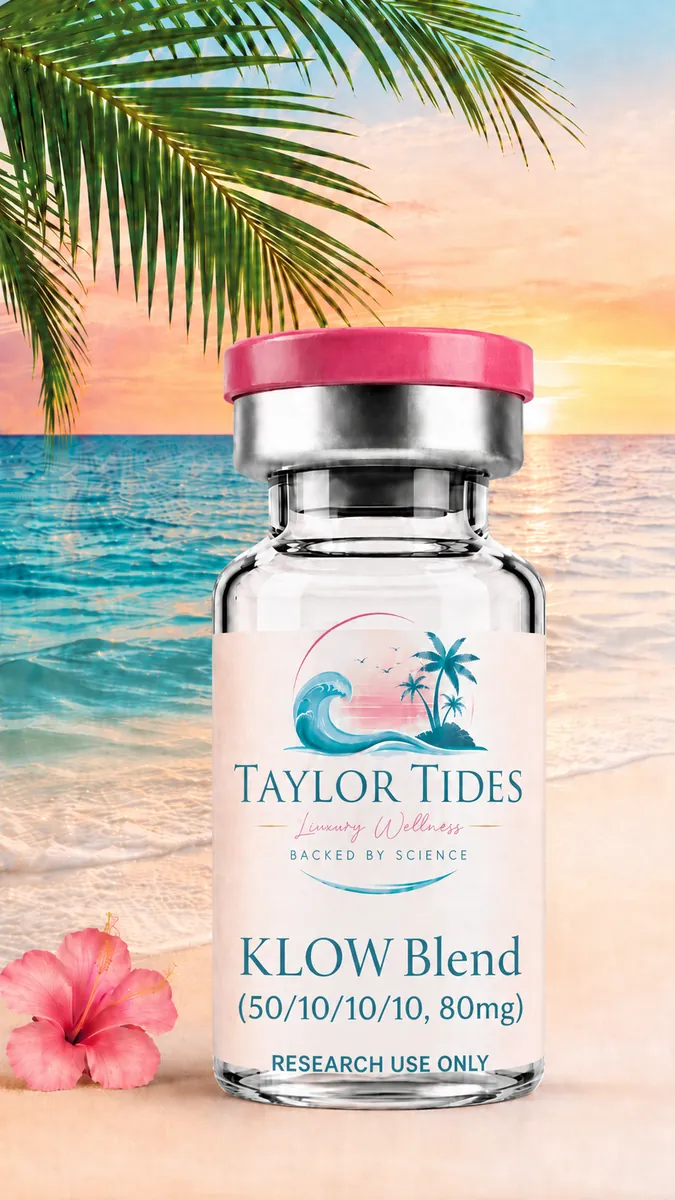
The KLOW peptide is not a single peptide. It is a blend that commonly contains GHK-Cu, BPC-157, TB-500 and KPV.
The blend is promoted for skin, tissue repair, inflammation, digestive health and recovery. Most of these claims come from laboratory research and animal studies of the individual ingredients. The complete KLOW blend has not been studied in controlled human trials.
This information explains what KLOW commonly contains, how it differs from GLOW and what remains unknown about its benefits, side effects and safety.
KLOW in 30 Seconds
- KLOW is the name of a blend, not the scientific name of a single peptide.
- It commonly contains GHK-Cu, BPC-157, TB-500 and KPV.
- KLOW is often described as GLOW with KPV added.
- “KLOW 80” commonly means the entire vial contains 80 milligrams. It is not an established human dose.
- Researchers have studied the ingredients separately, primarily in cells and animals.
- No controlled study has established that the complete blend is effective or safe in people.
- The ingredients and amounts can vary, so the label must be checked.
What Is KLOW Peptide?
KLOW is a mixture of four separate research compounds in a single vial. It may be called a peptide, blend or stack, meaning several compounds grouped together, but it is not a new molecule.
Imagine a box containing four different tools. Putting them in one box makes them easier to carry, but it does not turn them into one tool. The compounds inside KLOW still have different structures, possible effects and research histories.
KLOW is not a standardized medical or scientific name. Different companies may use it for different formulas.
What Does KLOW Commonly Contain?
A frequently promoted KLOW formula contains:
- 50 mg of GHK-Cu: A very short amino-acid chain attached to copper
- 10 mg of BPC-157: A chain of 15 amino acids made in a laboratory
- 10 mg of TB-500: A short fragment related to a larger protein called thymosin beta-4
- 10 mg of KPV: A chain of three amino acids
Together, these amounts total 80 mg. This is why the blend may be called “KLOW 80.”
The total describes what the manufacturer claims is inside the entire vial. It is not a recommended dose, daily amount or established medical protocol.
A label showing only 50/10/10/10 is incomplete unless it identifies which ingredient corresponds to each number. The name KLOW alone cannot confirm the formula.
KLOW vs GLOW: What Is the Difference?
GLOW commonly contains GHK-Cu, BPC-157 and TB-500. KLOW commonly contains those three compounds plus KPV.
KLOW is commonly presented as GLOW with KPV added.
KPV is included because laboratory and animal studies have examined its possible effects on signals related to inflammation. This is why KLOW is often promoted for inflammation, digestive concerns and inflammatory skin conditions.
That does not mean KLOW works better. No controlled study has directly compared KLOW with GLOW or established that adding KPV provides an additional benefit in people.
More ingredients can also mean more uncertainty, possible side effects and difficulty identifying which compound caused a reaction.
Why Can KLOW Look Blue?
A prepared KLOW blend may look blue or blue-green because GHK-Cu contains copper. The color does not necessarily mean that a dye was added.
Color alone cannot confirm:
- That all four ingredients are present
- The amount of each ingredient
- Purity
- Sterility, meaning the absence of living germs
- Proper storage
A blue color may be consistent with the presence of GHK-Cu, but it cannot replace testing performed by an independent laboratory.
What Does Research Show About the Ingredients?
Each ingredient has its own research history. Studying the ingredients separately does not establish how the complete KLOW blend behaves.
GHK-Cu
GHK-Cu carries copper. Researchers have studied its effects on collagen, skin cells and processes related to wound healing.
Collagen is one of the materials that gives skin and other tissues structure and strength. Results obtained from cells, animals or products applied to the skin do not demonstrate that injected GHK-Cu improves wrinkles, scars, loose skin or hair growth.
BPC-157
Animal studies have examined BPC-157 in relation to tendons, ligaments, muscles and digestive tissues. These findings help explain why it is promoted for recovery and digestive concerns.
Reliable human research remains extremely limited. Healing results in animals cannot establish that BPC-157 works safely or effectively in people.
TB-500
TB-500 is commonly described as a fragment, meaning a small piece related to thymosin beta-4.
Thymosin beta-4 is a larger natural protein involved in cell movement and tissue-repair processes. Many claims about TB-500 come from studies of that larger protein. Research involving complete thymosin beta-4 cannot automatically be treated as evidence about the smaller TB-500 fragment sold in vials.
KPV
KPV consists of three amino acids: lysine, proline and valine.
Laboratory and mouse studies have examined its possible effects on signals related to inflammation, including experimental intestinal inflammation. These studies do not establish that KPV treats digestive diseases, skin conditions or general inflammation in people.
Has the Complete KLOW Blend Been Studied?
I found no controlled study that evaluated the complete four-compound KLOW blend in animals or humans.
Several important questions remain unanswered:
- Do the ingredients remain stable when combined?
- Does one ingredient change how another behaves?
- Does combining them improve any outcome?
- Does the mixture produce different side effects?
- How does the body process all four compounds together?
The idea behind KLOW may sound logical. It remains a hypothesis until the complete mixture is properly studied.
Possible Benefits: Claims Compared With Evidence
KLOW is promoted for skin appearance, collagen production, hair health, tissue repair, recovery, digestive health and inflammation.
The evidence does not demonstrate these benefits for the complete blend:
- Claims about skin and collagen rely primarily on laboratory research involving GHK-Cu and limited evidence involving topical products.
- Claims about tissue repair and recovery depend largely on animal studies involving BPC-157 and thymosin beta-4.
- Claims about inflammation and digestive health are supported partly by KPV studies conducted in cells and mice.
- None of these separate findings demonstrates that injected KLOW produces the advertised results in people.
KLOW has also not been proven to treat inflammatory bowel disease, irritable bowel syndrome, eczema, psoriasis, injuries or another medical condition.
What Can Before-and-After Reports Tell Us?
Photographs and personal stories show what people hope to change. They cannot establish that KLOW caused a result.
A person may also have changed medications, skin products, diet, exercise, sleep, weight, supplements or other research compounds. Lighting, camera angle and image editing can affect photographs.
It may also be impossible to verify what the vial actually contained. Before-and-after reports can generate questions for future research, but they are not controlled evidence.
Possible Side Effects and Unknowns
KLOW does not have an established safety profile because the complete blend has not been properly studied in people.
Possible concerns include:
- Pain, redness, swelling or irritation where a product is injected
- Allergic or immune-system reactions
- Infections caused by contamination
- Incorrect ingredients or amounts
- Impurities produced during manufacturing
- Unknown interactions among the four compounds
- Unknown interactions with medications or medical conditions
Some ingredients may affect cell movement, collagen formation or the growth of small blood vessels involved in healing. Changing these processes may not be appropriate for everyone. People with cancer, unexplained growths or serious medical conditions should discuss these concerns with a qualified medical professional.
Competitive athletes should also review current anti-doping rules. BPC-157 is prohibited by the World Anti-Doping Agency.
Product Testing and Quality
The name, packaging and blue color cannot verify what a KLOW vial contains.
A useful laboratory report should identify:
- Each expected ingredient
- The measured amount or concentration
- Purity
- The batch or lot tested
- The testing date
- The laboratory
Purity and sterility answer different questions. A product can contain the expected compounds and still be contaminated with bacteria, bacterial toxins or other unwanted materials.
A Certificate of Analysis, commonly called a COA, is most useful when it comes from an independent laboratory and matches the exact batch being considered.
Questions for a Medical Professional
- What problem am I trying to understand?
- Is there a better-studied alternative?
- Could any ingredient conflict with my medications or medical history?
- What human evidence supports the expected benefit?
- Which side effects require medical attention?
- How were identity, purity and sterility evaluated?
- Would combining several compounds make a reaction more difficult to investigate?
These questions help turn claims found online into a better-informed medical conversation.
Frequently Asked Questions About KLOW Peptide
Is KLOW a Single Peptide?
No. KLOW is a nonstandardized name commonly used for a blend of GHK-Cu, BPC-157, TB-500 and KPV.
What Does KLOW 80 Mean?
KLOW 80 commonly means that the entire vial contains 80 milligrams across its listed ingredients. It is not an established human dose.
What Is the Difference Between KLOW and GLOW?
KLOW commonly contains the three compounds associated with GLOW, which are GHK-Cu, BPC-157 and TB-500, plus KPV. No controlled study has established that KLOW works better than GLOW.
Why Can KLOW Look Blue?
KLOW may look blue or blue-green because GHK-Cu contains copper. Color cannot confirm the identity, amount, purity or sterility of the product.
Has the Complete KLOW Blend Been Studied?
No controlled study was found that tested the complete four-compound KLOW blend in animals or humans. Research on the separate ingredients does not establish how the complete mixture behaves.
Is the KLOW Peptide Blend Safe?
The complete KLOW blend does not have an established human safety profile. Possible concerns include contamination, incorrect ingredients, manufacturing impurities, immune reactions and unknown interactions.
This page provides general educational information. It does not diagnose a condition, recommend a product or provide dosing, mixing, reconstitution or injection instructions.
KLOW is not a standardized medical name, and products using that name may differ. The complete blend has not been established as safe or effective through controlled human studies.
Taylor Tides is not a medical provider. Speak with a qualified medical professional before making decisions involving your health, medications or a KLOW peptide blend.
Sources and Further Reading
- PubMed: GHK-Cu and Collagen Synthesis in Laboratory-Grown Cells
- PubMed: Review of Topical GHK and Limitations in the Clinical Evidence
- PubMed: Systematic Review of BPC-157 Research
- PubMed: BPC-157 and Ligament Research in Rats
- PubMed: TB-500 Metabolism and Laboratory Wound-Healing Activity
- PubMed: Thymosin Beta-4 and Wound-Healing Research in Rats
- PubMed: KPV and Signals Related to Intestinal Inflammation
- PubMed: KPV Research in Mouse Models of Colitis
- FDA: Safety Questions Involving Certain Compounded Peptide Substances
- World Anti-Doping Agency: 2026 Prohibited List
Reddit and other public forums were reviewed to identify common questions, confusion and self-reported experiences. Anecdotes were not used as evidence of medical benefits, safety or appropriate use.
Author: TaylorTides. Medical review status: Not reviewed by a licensed clinician. Research reviewed: September 1, 2026.