
Educational Guide
Wolverine Stack: What It Is, What It Contains, and What the Research Shows
A plain-language guide to BPC-157 and TB-500, claimed recovery benefits, the 2026 combination study, safety questions, and what remains unknown.
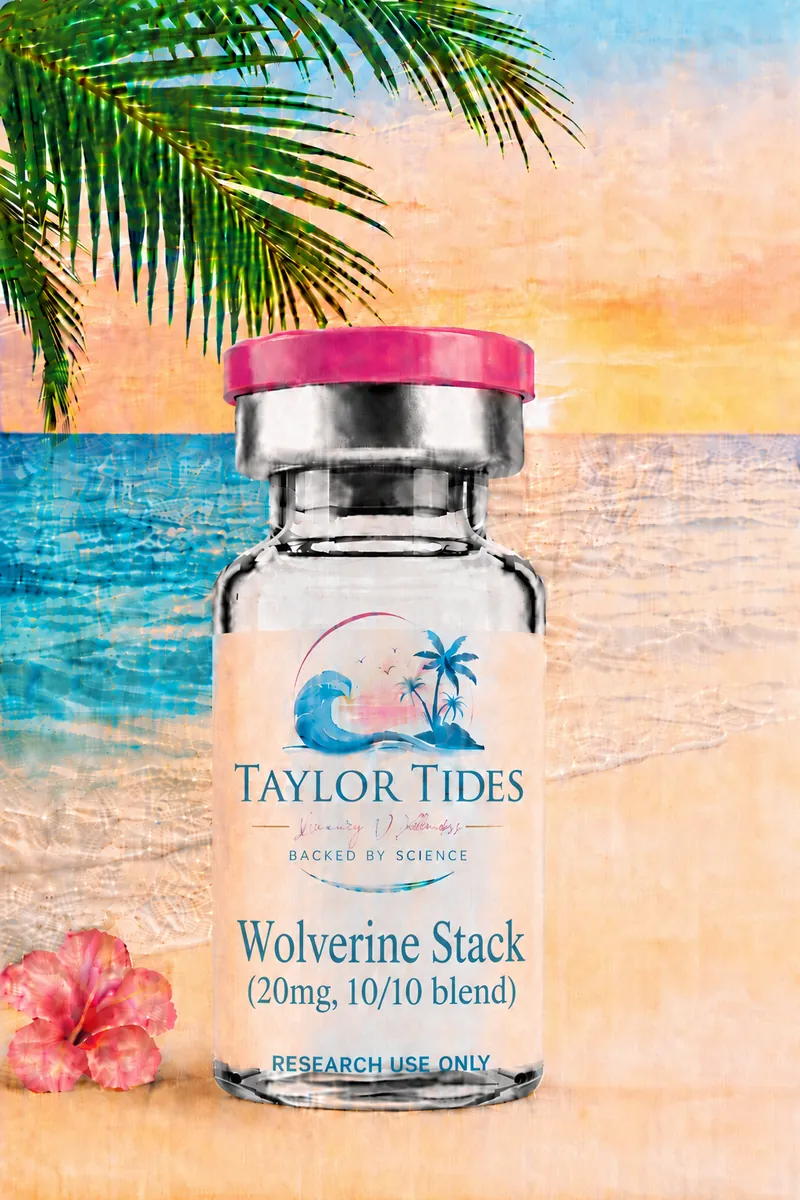
The Wolverine Stack is an informal name for combining two experimental peptides: BPC-157 and TB-500. Despite its name, it is not one peptide, a standardized medication, or an FDA-approved treatment.
People commonly encounter this term while researching injuries, persistent pain, recovery after surgery, or physical recovery. The name suggests comic-book-style healing, but reliable human research has not established that combining these peptides safely improves recovery in people.
The Wolverine Stack in 30 Seconds
- The Wolverine Stack usually means combining BPC-157 with TB-500.
- People research it for tendon, ligament, muscle, joint, and surgical recovery.
- It is a nickname, not a single peptide or an approved medical product.
- A 2026 study in rats evaluated the peptides separately and together. The combination did not provide an additional benefit.
- That animal study cannot establish whether the combination works or is safe in humans.
- There is no standardized formula, dose, ratio, or treatment schedule for the Wolverine Stack.
Why Is It Called the Wolverine Stack, and What Does “Stack” Mean?
The nickname refers to Wolverine, the fictional character known for recovering quickly after an injury.
In peptide, supplement, and fitness communities, a stack means using more than one substance at the same time. This does not prove that the substances work better together or that the combination has been scientifically studied.
Think of it as putting two ingredients into the same recipe. Their being together does not tell us whether the recipe works, whether the amounts are appropriate, or whether the ingredients could interact unexpectedly.
“Wolverine Stack” is a term used by online communities and advertisers. It is not a pharmaceutical name or a recognized medical protocol.
Is the Wolverine Stack a Single Peptide?
No. It generally contains two different experimental peptides:
- BPC-157
- TB-500
A peptide is a short chain of amino acids. You can think of amino acids as small building materials that the body connects to perform different jobs.
BPC-157
BPC-157 is a laboratory-made peptide composed of 15 amino acids. Researchers have studied its possible effects related to tissue repair, inflammation, blood vessels, and the digestive system. Most of the supporting evidence comes from laboratory and animal studies.
TB-500
TB-500 is a laboratory-made peptide composed of seven amino acids. It copies a small section of a larger peptide produced by the body called thymosin beta-4.
One useful mental image is to think of thymosin beta-4 as a complete sentence and TB-500 as a phrase copied from that sentence. We should not assume that the phrase can perform all the jobs of the complete sentence.
Taylor Tides has separate plain-language guides about BPC-157 and TB-500 for readers who want to explore these topics further.
Why Do People Combine BPC-157 and TB-500?
People commonly research this combination for issues related to:
- Tendon and ligament injuries
- Muscle strains or tears
- Shoulder, knee, and elbow problems
- Joint pain or stiffness
- Recovery after surgery
- Wound healing
- Exercise recovery
- Persistent pain
These are reasons people research the Wolverine Stack. They are not proven medical uses.
Supporters of the combination assume the two peptides influence different parts of the repair process and will produce a stronger result when used together. The explanation may sound logical, but a possible explanation is not the same as clinical evidence.
Does BPC-157 Work Locally While TB-500 Works Throughout the Body?
Online explanations frequently claim that BPC-157 works locally at a specific injury, TB-500 works systemically throughout the body, and combining them produces both localized and whole-body repair.
This explanation is easy to remember. Reliable human research has not demonstrated that it is true.
The combination should not be described as complementary or synergistic unless evidence demonstrates an additional benefit from using both substances together.
What Has Actually Been Studied?
Claims about the Wolverine Stack use several different types of evidence:
- Laboratory experiments involving cells or tissues
- Animal studies
- Research on BPC-157 or TB-500 separately
- Research on complete thymosin beta-4
- Research on the actual combination of BPC-157 and TB-500
These forms of evidence do not answer the same question. Laboratory and animal research can identify possibilities. They cannot establish that a commercial product safely heals an injury in a person.
What Did the 2026 Study Find About the Combination?
A 2026 study of BPC-157, TB-500, and the combination compared both peptides, their combination, and a control treatment in 32 male rats whose Achilles tendons had been surgically injured and repaired.
After four weeks, the researchers examined the strength and structure of the tendons. Some results favored the groups that received the individual peptides.
However, combining BPC-157 and TB-500 did not produce an additional benefit compared with using either peptide separately.
This result matters because the Wolverine Stack is commonly promoted under the assumption that the two substances work better together.
The study still cannot answer questions about human use:
- It involved rats, not people.
- Each group contained only eight animals.
- It examined one surgically created injury.
- It did not evaluate commercial products sold under the Wolverine name.
- It did not establish benefits, risks, doses, or treatment schedules for humans.
- It did not determine whether the results continued beyond four weeks.
The study provides a useful clue for future research. It does not establish the Wolverine Stack as a treatment for humans.
Does the Wolverine Stack Work in People?
We do not have reliable human evidence demonstrating that the Wolverine Stack heals injuries or improves recovery.
A convincing human study would need to compare BPC-157 alone, TB-500 alone, the combination, and an appropriate control group. Participants would need comparable injuries, rehabilitation programs, and measurements of their results.
Until that research exists, stories about extraordinary recoveries remain personal experiences. They do not prove that the Wolverine Stack caused the improvement.
Claimed Wolverine Stack Benefits Versus the Evidence
| Common claim | What the evidence currently allows us to say |
|---|---|
| “It heals tendons and ligaments.” | Laboratory and animal research has examined tissue repair, but reliable human studies have not established this benefit. |
| “It speeds recovery after surgery.” | Personal experiences cannot separate the effects of the peptides from surgery, rehabilitation, rest, and natural recovery. |
| “BPC-157 repairs the injury while TB-500 repairs the whole body.” | This explanation is popular online, but reliable human research has not demonstrated it. |
| “The peptides work better together.” | The 2026 rat study did not find an additional benefit from the combination. Human studies are still needed. |
| “Less pain means the injury has healed.” | Pain can improve without demonstrating that the injured tissue has regained its strength. |
| “It is safe because peptides occur naturally in the body.” | Manufactured products can present biological and quality risks regardless of their relationship to naturally occurring substances. |
Wolverine Stack Safety: Both the Peptides and the Product Matter
The Wolverine Stack does not have a well-established safety profile in humans. Researchers still cannot identify every possible side effect, determine how frequently side effects occur, or know who might face greater risks.
Online, some people report headaches, dizziness, anxiety, sleep changes, heart palpitations, swelling, tiredness, mood changes, and visual disturbances. Other people report experiencing no unwanted symptoms.
These are personal accounts, not a clinically established list of side effects. Products, amounts, medical conditions, and additional substances often differ. These stories cannot prove what caused a symptom or how frequently it might occur.
The FDA reviewed a report of an adverse effect associated with a product containing BPC-157 and TB-500. The person developed changes in the color of their skin and gums. According to the report, the reaction returned when the person used the product again and disappeared after the product was discontinued.
The report suggests a possible connection with the product, but it cannot identify whether the cause was one peptide, an interaction between the two peptides, an impurity, or another product characteristic. A single report also cannot tell us how frequently such a reaction occurs.
FDA reviewers have identified broader concerns related to:
- Possible immune-system reactions
- Peptide material collecting or clumping together, known as aggregation
- Peptide-related impurities
- Difficulty confirming the exact active ingredient
- Limited information about human exposure
- Inadequate evidence about long-term safety
The Wolverine name does not establish what a product actually contains. Different products may use different amounts, ratios, forms, or additional ingredients.
A label stating “for research purposes only” does not prove identity, purity, potency, sterility, safety, effectiveness, or medical suitability.
A laboratory report or Certificate of Analysis may answer a limited question about specific testing. It does not automatically establish every quality on this list.
Premixed Products Versus Separate Products
Reliable human research has not established whether a premixed product or separate peptides are safer or more effective.
A combined product makes the results more difficult to interpret. If someone experiences an improvement or an unwanted symptom, it may be difficult to identify whether the responsible factor was one peptide, an interaction, or a product-quality problem.
Premixed products also use a fixed ratio selected by the manufacturer or seller. The Wolverine name does not establish that the ratio has been clinically studied.
Taylor Tides does not provide instructions for purchasing, mixing, dosing, or injecting experimental peptides.
Does Feeling Better Mean the Injury Has Healed?
No. Experiencing less pain and confirming that tissue has recovered are not the same outcome.
Less pain, reduced swelling, improved movement, greater strength, and structural tissue repair are different measurements. They may be related, but one does not automatically prove the others.
Someone who feels better may return to activity before the injured tissue can safely handle the strain. A qualified professional may use a physical evaluation, strength testing, movement analysis, or medical imaging to assess recovery.
Is the Wolverine Stack Approved by the FDA?
No. The Wolverine Stack, BPC-157, and TB-500 are not FDA-approved medications or treatments.
In July 2026, an FDA advisory committee considered substances related to BPC-157 and TB-500 for certain decisions involving medications prepared by specialized compounding pharmacies.
An advisory committee recommendation is not the same as FDA drug approval. The committee’s activity does not establish that the combination is safe, effective, or appropriate for an injury.
“Available through a clinic,” “prepared by a specialized compounding pharmacy,” “research grade,” and “FDA approved” do not mean the same thing.
Is the Wolverine Stack Prohibited for Athletes?
Yes. Both components create concerns under anti-doping rules.
BPC-157 is prohibited as an unapproved substance. The World Anti-Doping Agency also prohibits thymosin beta-4 and its derivatives, including TB-500.
Competitive athletes should verify any substance with their sports organization or a qualified anti-doping resource before using it.
How to Evaluate Wolverine Stack Claims
- Was the research conducted in people, animals, or laboratory cells?
- Did it evaluate BPC-157, TB-500, or the actual combination?
- Did it use TB-500 or complete thymosin beta-4?
- Was there an appropriate comparison group?
- Was the injury clearly diagnosed?
- Did the study consider rehabilitation, rest, and natural recovery?
- Did the researchers measure pain, movement, strength, or tissue structure?
- Was the product independently tested?
- Is the source an independent researcher, clinic, seller, affiliate, or forum participant?
- Does the claim acknowledge uncertainty and negative findings?
A trustworthy explanation should clearly show where the evidence ends.
Questions to Discuss With a Healthcare Professional
- What is the actual diagnosis?
- Could continuing the activity make the injury worse?
- What established treatments are available?
- Has this combination been studied in people with this injury?
- What safety information is still missing?
- Could other medications or medical conditions affect the risks?
- How would improvement or recovery be measured?
- What warning signs require medical attention?
The most useful first step may be understanding the injury rather than choosing a peptide.
Frequently Asked Questions
What is the Wolverine Stack?
The Wolverine Stack is an informal name that usually describes combining BPC-157 and TB-500. It is not one peptide, a standardized medication, or an FDA-approved treatment.
What peptides are in the Wolverine Stack?
The name generally refers to BPC-157 and TB-500. It does not guarantee a particular ratio, concentration, form, or level of quality.
Does the Wolverine Stack work?
Reliable human studies have not established that the combination heals injuries or improves recovery.
What did the 2026 Wolverine Stack study find?
A rat study evaluated BPC-157, TB-500, and the combination following an Achilles tendon injury. Combining the peptides did not provide an additional benefit compared with using them separately.
What are the claimed Wolverine Stack benefits?
People research the combination for tendon, ligament, muscle, joint, wound, and surgical recovery. These are proposed benefits, not established medical uses in humans.
What are the possible Wolverine Stack side effects?
The combination does not have a well-established safety profile in humans. People report different symptoms online, but those accounts cannot prove their cause or frequency.
Is the Wolverine Stack FDA approved?
No. The Wolverine Stack, BPC-157, and TB-500 are not FDA-approved medications or treatments.
Is the Wolverine Stack prohibited in sports?
Both components raise concerns under anti-doping rules. BPC-157 is prohibited as an unapproved substance, and the World Anti-Doping Agency prohibits thymosin beta-4 derivatives, including TB-500.
Conclusion
The Wolverine Stack is a memorable name for combining BPC-157 and TB-500. The name is much stronger than the available human evidence.
A 2026 rat study evaluated the two peptides separately and together. The combination did not provide an additional benefit compared with either peptide alone, and the study cannot establish whether the Wolverine Stack works or is safe in people.
Human evidence remains inadequate. Product formulations are inconsistent, long-term risks are not well defined, and neither peptide is an FDA-approved treatment.
An informed decision begins with understanding the injury, separating personal experiences from clinical evidence, and asking how recovery will be measured. These questions are more valuable than assuming the name promises extraordinary healing. That is the responsible starting point when researching the Wolverine Stack.
This page provides general educational information. It does not diagnose an injury, recommend a peptide, establish the safety of a product, or replace advice from a qualified and licensed healthcare professional.
Sources and Further Reading
- FDA: July 2026 Pharmacy Compounding Advisory Committee materials
- FDA: Bulk drug substances that may present significant safety risks
- PubMed: 2026 BPC-157, TB-500, and combination Achilles tendon study in rats
- PubMed: 2026 scoping review of emerging peptide supplements in sports medicine
- PubMed: Review of injectable peptide therapies in orthopedics and sports medicine
- World Anti-Doping Agency: 2026 Prohibited List
Author: TaylorTides. Medical review status: Not reviewed by a licensed clinician. Research reviewed: August 28, 2026.