
Molecule Library
Semax Peptide: What It Is, Possible Benefits, Side Effects and Research
Helpful information about Semax peptide, cognitive claims, human evidence, nasal products, side effects, FDA status and unanswered questions.
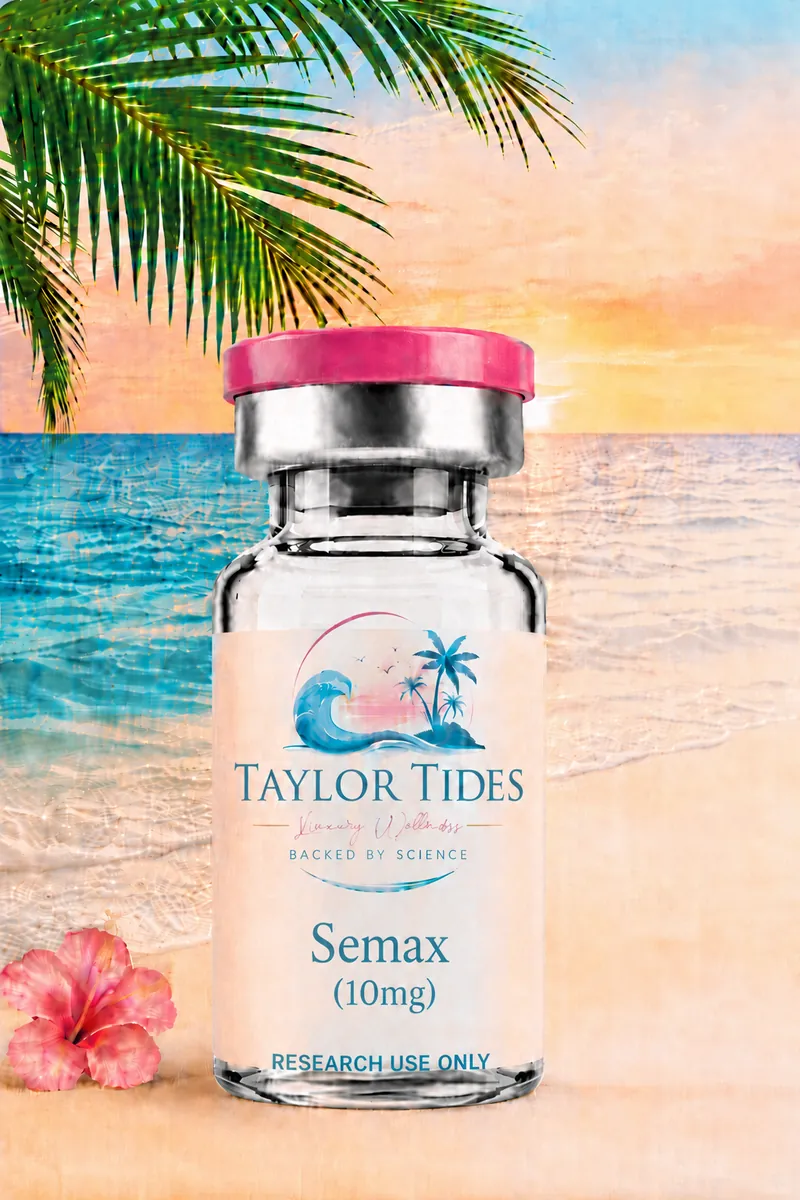
Semax peptide is a chain of seven amino acids made in a laboratory. It is researched and promoted for focus, memory, brain fog, mood and neurological recovery, but reliable human research has not demonstrated many of these claimed benefits.
Semax is often described as a nootropic. A nootropic is a substance promoted or studied for possible effects on thinking, attention or memory. The label explains why people are interested in Semax. It does not demonstrate that Semax improves mental performance.
Semax is registered as a medicine in Russia in certain nasal formulations. It is not an FDA-approved medication in the United States.
Semax in 30 Seconds
- Semax is a manufactured peptide containing seven amino acids.
- It is commonly promoted for focus, memory and mental performance.
- Semax is registered as a medicine in Russia but is not FDA approved in the United States.
- Most published human research used nasal administration.
- Human evidence for the most common cognitive and wellness claims remains limited.
- Semax, Semax acetate and N-acetyl Semax amidate are different forms or modified versions.
- Online experiences range from better focus to no effect, anxiety, fatigue, headache and brain fog.
- Important questions remain about effectiveness, long-term safety and product quality.
What Is Semax?
Semax is a small peptide made in a laboratory. A peptide is a short chain of amino acids, which are small building materials the body joins together to perform different jobs.
Semax contains seven amino acids. Scientists call it a heptapeptide. “Hepta” means seven.
The order of the amino acids matters. Changing the pieces or their arrangement can change how a peptide behaves.
Semax was designed from a small part of a natural hormone connected to the body’s stress-response system. It is not the complete hormone and should not be assumed to produce the same effects.
Scientists describe Semax as a synthetic analog of an ACTH fragment. In ordinary language, it is a manufactured peptide partly patterned after one small piece of a natural body signal.
What Is Semax Supposed to Do?
Semax is commonly promoted for focus and attention, memory and learning, motivation, mental clarity, brain fog, mood, recovery after neurological injury and protection of brain and nerve cells.
These possible benefits come from laboratory research, animal experiments, small human studies, medical use in Russia, product promotion and personal experiences. They do not all carry the same level of evidence.
Some studies measured brain-derived neurotrophic factor, or BDNF. BDNF is a protein involved in the survival and adaptation of brain cells.
A higher BDNF measurement does not demonstrate that Semax repaired the brain or improved thinking. A change in a laboratory measurement and a meaningful improvement in daily life are different outcomes.
Does Semax Improve Focus, Memory or Brain Fog?
The available human evidence is not strong enough to know.
Small studies involving healthy volunteers found changes in brain activity after Semax was administered through the nose. Researchers used brain imaging to observe communication between different parts of the brain.
A brain image can show that something changed. By itself, it cannot establish that the change was useful, noticeable or lasting.
These studies did not demonstrate reliable improvements in attention, memory, work or school performance, motivation, brain fog or everyday decision-making.
Online experiences are mixed. Some people describe more focus, clearer thoughts or better motivation. Others notice no effect or say they felt less focused. These experiences reveal questions worth studying, but they cannot establish how often a benefit occurs or whether Semax caused it.
Does Semax Help With ADHD?
Semax is not an FDA-approved ADHD treatment. Current human evidence does not demonstrate that it treats ADHD safely or effectively.
Difficulty concentrating does not always mean someone has ADHD. Attention problems can also be connected to sleep, anxiety, depression, medication effects, substance use, thyroid disorders, anemia and other health problems.
Persistent attention problems may require a proper evaluation rather than self-treatment with a product promoted for focus.
What About Anxiety, Mood and Sleep?
Semax and Selank are often mentioned together, but they are different peptides. Semax is usually promoted for focus, motivation and mental performance. Selank is more often promoted for anxiety, stress and calmness.
Online accounts about Semax vary. Some people describe better motivation or mood. Others describe increased anxiety, irritability, restlessness, difficulty sleeping, mental sluggishness, fatigue or feeling overstimulated.
There is not enough reliable human evidence to conclude that Semax treats anxiety, depression or sleep problems. A reaction may also be influenced by caffeine, prescription medications, supplements, health problems, lack of sleep or several substances used together.
What Has Actually Been Studied in Humans?
Much of the published human research comes from Russia and involves people with neurological conditions, especially ischemic stroke.
An ischemic stroke happens when a blocked blood vessel prevents part of the brain from receiving enough blood and oxygen.
A 1997 study examined Semax alongside conventional treatment in people experiencing an ischemic stroke. Researchers reported differences in neurological recovery, but the study was relatively small and did not use the type of large, carefully controlled design normally expected to establish effectiveness.
A 2018 study followed 110 people during rehabilitation after a stroke. It reported higher BDNF measurements and better rehabilitation results in the groups receiving Semax.
These findings do not demonstrate benefits in generally healthy people or prove that Semax treats ADHD, improves studying or clears ordinary brain fog.
Other small studies used brain imaging to examine short-term changes after healthy volunteers received Semax through the nose. They found differences in brain activity but did not demonstrate meaningful improvements in everyday mental performance.
Animal and laboratory research has also explored inflammation, blood flow, lack of oxygen, brain-cell survival, learning and memory. Those studies help scientists form better questions. Human trials still need to determine whether a benefit actually occurs in people and whether a product is reasonably safe.
Semax should not replace emergency care or established stroke treatments. Sudden weakness, facial drooping, difficulty speaking, confusion or other possible stroke symptoms require immediate emergency care.
Why Is Semax Usually Discussed as a Nasal Spray?
Semax is commonly connected with nasal use because the medicine registered in Russia is offered as nasal drops and much of the available human research used intranasal administration.
Intranasal means administered through the nose.
US sellers may offer premixed nasal sprays, compounded nasal products, freeze-dried research material, injectable products, modified Semax-related peptides or blends containing Semax and Selank. These forms are not automatically interchangeable.
A nasal drop, a measured spray and an injection deliver a substance in different ways. The amount released by a spray can also depend on the concentration, liquid, bottle and pump.
Research involving a Russian nasal formulation cannot establish the safety or effectiveness of every nasal or injectable product sold under the Semax name. Human safety information about injectable Semax is especially limited.
Taylor Tides does not provide instructions for preparing nasal sprays, reconstituting Semax, calculating doses or administering injections.
Semax, Semax Acetate and N-Acetyl Semax Amidate
Products with similar names may contain different forms of Semax.
- Semax: The basic seven-amino-acid peptide, sometimes called Semax free base.
- Semax acetate: A salt form created by combining Semax with acetate.
- N-acetyl Semax amidate: A related Semax peptide that has been modified.
N-acetyl Semax amidate may also be called NA-Semax, N-acetyl Semax, NA-Semax amidate, Semax amidate or NASA in some online conversations.
These forms may behave differently. Research involving one form should not automatically be used to support another. A modified name also does not demonstrate that the product lasts longer, reaches the brain more effectively or provides greater benefits in people.
What Are the Possible Side Effects?
Semax’s safety profile has not been adequately characterized.
Effects described in product information, studies and community discussions include nasal irritation or burning, headache, nausea, dizziness or lightheadedness, fatigue, brain fog or mental sluggishness, anxiety or restlessness, irritability, sleep changes, increased heart rate and pressure or an unusual sensation in the head.
This list does not demonstrate that Semax caused every reported reaction or show how often an effect occurs.
The absence of a reported side effect does not demonstrate safety. A study may be too small or too short to detect an uncommon or delayed problem.
Why Does Product Quality Matter?
A Semax product raises several separate questions:
- Identity: Does it actually contain the form of Semax named on the label?
- Potency: Does it contain the stated amount?
- Purity: Are unwanted chemicals or peptide fragments present?
- Microbial quality: Does a nasal product contain unacceptable microbial contamination?
- Sterility: Is an injectable product free of living microorganisms?
- Endotoxins: Are harmful bacterial materials present?
- Stability: Does the product remain intact during storage and use?
- Delivery: Does the spray release a dependable amount?
- Effectiveness: Does the finished product provide the claimed benefit?
Passing one test does not answer the other questions.
A Certificate of Analysis may provide useful laboratory information, but it does not automatically demonstrate that a finished product is sterile, free of endotoxins, medically appropriate or effective.
Peptides can form clusters or contain impurities from manufacturing. Either problem can trigger an immune response. Available information does not demonstrate that every Semax product has been adequately tested for these risks.
Is Semax FDA Approved?
No. Semax is not an FDA-approved medication in the United States.
It is registered as a medicine in Russia in certain nasal formulations. Registration in another country does not mean every Semax product has the same formulation, manufacturing controls or supporting evidence.
In 2026, FDA staff recommended against adding Semax and Semax acetate to a federal list connected with certain compounded medicines. The agency identified insufficient evidence of effectiveness, limited safety information and unresolved manufacturing concerns.
The review does not demonstrate that every Semax product causes harm. It shows that the available information was not strong enough to resolve important questions about effectiveness, safety and quality.
A compounded Semax product is also not FDA approved.
Semax vs Selank
Semax and Selank are different peptides made in a laboratory.
| Question | Semax | Selank |
|---|---|---|
| Usually promoted for | Focus, memory and motivation | Anxiety, stress and calmness |
| Is a peptide | Yes | Yes |
| FDA approved in the United States | No | No |
| Strong evidence for common wellness claims | No | No |
This comparison describes how the peptides are commonly promoted. It does not demonstrate that either provides the claimed benefit.
Some products combine Semax and Selank. Research involving either peptide alone cannot establish that a combined product is safe or effective. Combining substances also makes it harder to identify what caused a benefit or unwanted reaction.
Questions to Ask About a Semax Product
- Does it contain Semax, Semax acetate, N-acetyl Semax amidate or a mixture?
- Is it a nasal product, injectable product or research material?
- What specific benefit is being claimed?
- Has that exact form and delivery method been studied in people for that purpose?
- Is it a compounded product?
- Was the finished product tested for identity, potency, purity and stability?
- Was a nasal product tested for microbial contamination and dependable delivery?
- Was an injectable product tested for sterility and endotoxins?
- Does the laboratory report identify the exact batch?
- What unwanted effects and unresolved questions have been reported?
- Who will respond if a serious reaction occurs?
- Could the symptoms being investigated have another cause that needs evaluation?
Frequently Asked Questions About Semax
What is Semax peptide?
Semax is a laboratory-made peptide containing seven amino acids. It was designed partly from a small part of a natural hormone, but it is not the complete hormone.
What is Semax used for?
Semax is registered as a medication in Russia in certain nasal formulations. In the United States, it is promoted for focus, memory, brain fog, mood and neurological recovery, but reliable human evidence does not demonstrate many of these uses.
Is Semax a nootropic?
Semax is commonly described as a nootropic because it is promoted and studied for its possible effects on thinking, attention and memory. The label does not demonstrate that it improves these functions.
Does Semax help with ADHD?
Semax is not an FDA-approved ADHD treatment. Current human evidence does not demonstrate that Semax treats ADHD safely or effectively.
Are Semax and N-acetyl Semax amidate the same?
No. N-acetyl Semax amidate is a modified Semax-related peptide. Research involving ordinary Semax should not automatically be applied to the modified version.
Is injectable Semax the same as nasal Semax?
The peptide name may be similar, but the delivery methods and finished products are not equivalent. Human safety information about injectable Semax is especially limited.
What is the difference between Semax and Selank?
They are different laboratory-made peptides. Semax is commonly promoted for focus and mental performance, while Selank is promoted for anxiety and calmness. Strong human evidence supporting these common wellness claims remains limited.
The Bottom Line
Semax is a manufactured seven-amino-acid peptide designed partly from a small piece of a natural hormone. It is registered as a medicine in Russia but is not FDA approved in the United States.
Some human studies have investigated Semax during stroke recovery and in small brain-imaging experiments. These results provide reasons for continued research, but they do not demonstrate that Semax improves focus, treats ADHD, clears brain fog, reduces anxiety or protects the brain in generally healthy people.
Useful questions include which form a product contains, how it was manufactured, whether the finished product was properly tested and whether meaningful human evidence supports its proposed purpose.
Those differences matter when evaluating information about the Semax peptide.
This information is provided only for general educational purposes. It does not diagnose a condition, recommend a product or replace individual advice from a qualified healthcare professional.
Taylor Tides does not provide instructions about dosing, cycling, preparing nasal sprays, reconstitution, injections, combinations or self-treatment with Semax.
Sudden neurological changes, a possible stroke, a severe headache, chest pain, difficulty breathing, fainting or a serious allergic reaction require immediate medical attention.
Sources and Further Reading
- FDA briefing document about Semax-related substances
- FDA Pharmacy Compounding Advisory Committee meeting, July 23 and 24, 2026
- FDA: Human drug compounding
- Semax during different stages of rehabilitation after ischemic stroke
- Semax during the acute phase of hemispheric ischemic stroke
- Semax effects on the brain’s default mode network
- Functional brain-connectivity research involving Semax and Selank
- Research involving N-terminal acetylation of Semax
Author: TaylorTides. Medical review status: Not reviewed by a licensed clinician. Research reviewed: August 30, 2026.