
Molecule Library
SS-31 Peptide: What It Is, What FDA Approved and What Research Shows
Helpful information about SS-31, elamipretide and Forzinity, including human research, possible side effects, FDA status and unanswered questions.
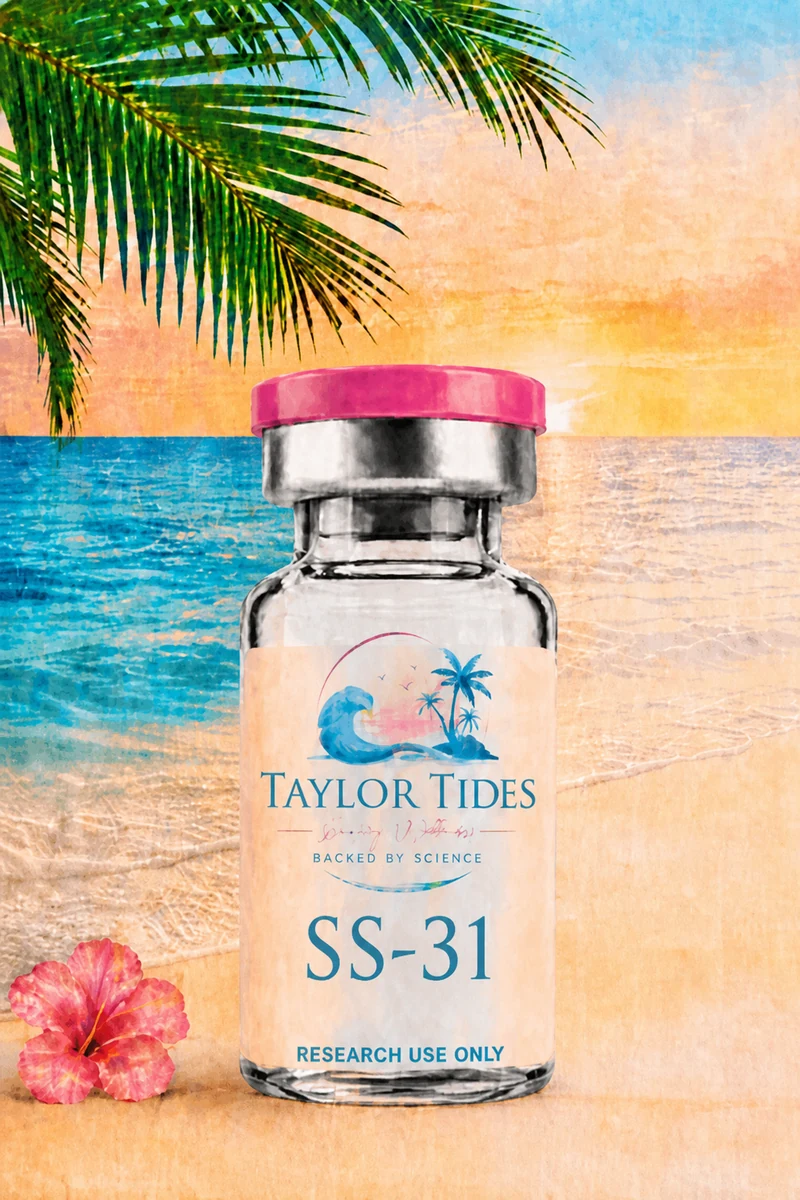
SS-31 peptide is a laboratory-made substance designed to work inside mitochondria, the small working parts of cells that help turn food and oxygen into energy the body can use.
Scientists later called SS-31 elamipretide. In 2025, FDA approved an elamipretide medicine called Forzinity for people with Barth syndrome who weigh at least 30 kilograms, or about 66 pounds. Barth syndrome is a rare inherited condition that interferes with how mitochondria work.
The approval is real but narrow. It does not include everyday tiredness, athletic performance, weight loss, anti-aging or general mitochondrial health. It also does not mean every vial sold online as SS-31 is the FDA-approved medicine.
This information explains that difference, what human studies found, the known risks and why using SS-31 before MOTS-C remains an unproven internet protocol.
SS-31 in 30 Seconds
- SS-31 and elamipretide refer to the same peptide. SS-31 and MTP-131 were development names.
- It contains four amino acids. Amino acids are small materials used to build peptides and proteins.
- It acts near the inner wall of mitochondria.
- One prescription product is FDA approved. The approval is for Forzinity in a specific group of people with Barth syndrome.
- It is not approved as a general energy, sports-performance or anti-aging treatment.
- Human research has produced mixed results. A larger Phase 3 trial did not improve walking ability or fatigue in people with inherited mitochondrial muscle diseases.
- Injection-site reactions are the best-established side effects. Serious allergic reactions have also occurred.
- Reliable human evidence does not show that SS-31 must be used before MOTS-C.
SS-31, Elamipretide, MTP-131, Bendavia and Forzinity
These names are related, but they do not always describe the same finished product.
- SS-31 was an early research name.
- MTP-131 was another development name.
- Bendavia was a proposed brand name during earlier research.
- Elamipretide is the scientific drug name.
- Forzinity is the FDA-approved prescription medicine containing elamipretide.
A research vial labeled “SS-31” should not automatically be treated as Forzinity. The approved medicine has a particular formula, strength, manufacturing process and medical use reviewed by FDA. An online product may borrow the peptide name without being the same finished medicine.
What Are Mitochondria, and What Does SS-31 Have to Do With Them?
Mitochondria are working parts inside most cells. They help convert nutrients and oxygen into usable energy.
They are often called the batteries of cells. That comparison helps, but mitochondria also help cells respond to stress and manage damaged parts.
Much of their energy-making work happens along a folded inner wall. That wall contains cardiolipin, a fat-like material that helps organize and support the energy-making equipment.
SS-31 was designed to enter cells, move toward that inner wall and bind to cardiolipin. Because SS-31 contains four amino acids, scientists call it a tetrapeptide. “Tetra” simply means four.
Researchers are studying whether this interaction helps mitochondria maintain their structure and function in certain medical conditions. Online, that idea often becomes “SS-31 repairs mitochondria.” That goes too far. Knowing where something acts can help explain how it might work, but it does not prove that it repairs every person’s mitochondria or produces a noticeable health benefit.
What Did FDA Actually Approve?
In September 2025, FDA approved Forzinity to improve muscle strength in adults and children with Barth syndrome who weigh at least 30 kilograms.
Barth syndrome is a rare inherited disease that primarily affects males. It can cause heart problems, muscle weakness, poor stamina, growth difficulties and other serious complications.
FDA based the approval on improved strength in the muscles used to straighten the knee. The agency considered that change reasonably likely to predict a practical benefit, such as standing more easily or walking farther. The study did not directly prove those broader improvements, so FDA used its accelerated approval process.
Accelerated approval allows a drug for a serious condition to reach patients using an early measurement reasonably likely to predict meaningful benefit. The manufacturer must then conduct additional research to confirm that benefit. In plain language, the approval is valid, but the evidence is still being completed.
The approval applies to one product, condition, patient group and medical purpose. People with Barth syndrome do not represent healthy adults seeking energy, athletes researching performance or consumers interested in anti-aging.
Does FDA Approval Include Every SS-31 Product?
No. FDA approved Forzinity as a complete prescription medicine. An online vial labeled SS-31 may share the peptide name without sharing the approved medicine’s formula, manufacturing controls, packaging or medical supervision.
A laboratory report may provide information about identity, concentration or certain impurities. It does not automatically establish sterility, safety, effectiveness or whether a product is medically appropriate. “Research use only” also does not mean FDA approved for human use.
What Have Human Studies Found?
Researchers have studied elamipretide in people with Barth syndrome, inherited mitochondrial diseases, heart failure and certain age-related changes in muscle energy. The results have not been consistently positive.
An early study involving 36 adults with primary mitochondrial myopathy found a possible improvement in walking distance after five days at the highest amount studied. Primary mitochondrial myopathy is a group of inherited diseases that prevents muscles from making and using energy normally.
A later crossover study involving 30 people found encouraging changes in some reports of tiredness. However, the difference in walking distance, the main result the study planned to measure, could not be separated confidently from chance.
Researchers then conducted a Phase 3 trial involving 218 people with primary mitochondrial myopathy. After 24 weeks, elamipretide did not improve walking distance or fatigue compared with placebo.
A placebo is an inactive comparison treatment. It helps researchers determine whether changes probably came from the drug rather than expectations, normal variation or other influences. The larger trial matters because promising findings from small or short studies can disappear when more people are studied for longer.
Does SS-31 Improve Energy, Exercise or Healthy Aging?
SS-31 is often marketed as an energy peptide. The reasoning sounds simple: mitochondria help produce energy, and SS-31 acts near mitochondria, so SS-31 must provide more energy.
Human evidence does not support that broad conclusion.
A small study involving 39 selected adults ages 60 to 85 found that one dose changed a laboratory measurement related to how quickly their muscle mitochondria could produce energy. That did not show that SS-31 acts as a stimulant, gives healthy people more energy or improves long-term physical performance.
It also did not show that SS-31 slows aging, prevents age-related disease, protects memory or helps people live longer.
Online experiences vary. Some people describe steadier energy, more endurance or less brain fog. Others report tiredness, headaches, flu-like feelings or no noticeable effect. These accounts identify questions worth researching, but they cannot tell us how often an effect occurs, what caused it or what another person should expect.
SS-31 Side Effects and Safety
The clearest safety information comes from studies of prescription elamipretide.
Injection-site reactions are the most frequently reported side effects. These can include redness, pain, itching, bruising, swelling, hardened skin or raised hive-like areas.
FDA also warns that serious allergic reactions have occurred. Reported signs have included skin reactions and breathing symptoms. A reaction may occur shortly after treatment begins or after several months.
People discussing SS-31 online have also described tiredness, headaches, nausea, stomach problems, sleep changes and flu-like feelings. These reports cannot prove that SS-31 caused the symptoms. Many people used several substances, and the product’s identity and quality could not be confirmed.
Safety information for the approved medicine may not predict the risks of an online vial with uncertain formulation, strength or sterility. Anyone experiencing difficulty breathing, severe swelling or another possible serious allergic reaction should seek emergency medical care.
Do You Need SS-31 Before MOTS-C?
Reliable human evidence does not show that SS-31 must be used before MOTS-C.
Online explanations often say SS-31 repairs the mitochondrial “engine” before MOTS-C makes it work harder. The comparison is memorable, but it is not an established medical protocol.
No adequate controlled human study has shown that using SS-31 first repairs damaged mitochondria, prevents MOTS-C side effects, makes MOTS-C work better or creates a safer treatment sequence.
Age alone does not prove that someone’s mitochondria are damaged. Feeling tired does not confirm a mitochondrial disease, and feeling worse after using SS-31 does not prove that repair is occurring.
Using SS-31 before MOTS-C remains a popular internet theory, not an established medical requirement.
SS-31 Compared With MOTS-C
SS-31 and MOTS-C are different peptides.
SS-31 is laboratory-made and designed to bind near the inner wall of mitochondria. One elamipretide medicine has a narrow FDA-approved use for Barth syndrome.
MOTS-C is naturally produced by the body from instructions stored inside mitochondria. Scientists are studying its possible role in energy use, exercise and the body’s response to physical stress. Synthetic MOTS-C is not an FDA-approved medicine.
- SS-31 is designed to interact with part of mitochondrial structure.
- Natural MOTS-C appears to work more like a message related to energy use and stress.
This does not prove that one repairs an engine while the other adds fuel, or that they work better together.
How Can You Evaluate an SS-31 Claim?
- Was the research conducted in people, animals or isolated cells?
- Who participated? Results in people with rare mitochondrial diseases may not apply to healthy consumers.
- What did researchers measure? A laboratory change does not automatically equal more energy or better health.
- Was there a placebo comparison?
- Did the study improve the main result it planned to measure?
- How many people were studied and for how long?
- Does the claim concern Forzinity or an online product labeled SS-31?
- Does the source explain uncertainty, or does it move directly into selling a protocol?
Be cautious with claims such as “repairs mitochondria,” “reverses aging,” “guaranteed cellular energy,” “no side effects” or “required before MOTS-C.” They make uncertain research sound settled.
What Can Product Testing Prove?
Depending on the test and sample, a report may provide information about chemical identity, concentration or certain impurities. It cannot automatically establish that the consumer’s vial came from the tested batch, every vial is identical, the product stayed stable during shipping, it is sterile, it is safe or effective in people, or it is medically appropriate.
A Certificate of Analysis is one source of information. It is not FDA approval and does not establish medical suitability.
Frequently Asked Questions About SS-31
Does the body produce SS-31 naturally?
No. SS-31 is a laboratory-made peptide designed to enter cells and interact with the inner wall of mitochondria.
Is SS-31 FDA approved?
The FDA approved Forzinity, a specific prescription medicine containing elamipretide, for certain patients with Barth syndrome who weigh at least 30 kilograms. That approval does not apply to every product sold or described online as SS-31.
Does SS-31 provide energy?
SS-31 has not been proven to provide dependable energy benefits in healthy people. Human studies in specific medical populations have produced mixed results.
What are the side effects of SS-31?
Clinical studies of prescription elamipretide commonly reported reactions where it was injected, and the FDA label warns about serious allergic reactions. Symptoms reported in online discussions cannot establish what caused them.
Is there an established SS-31 dosage?
An approved prescription dosage exists for eligible patients using Forzinity for Barth syndrome. There is no FDA-approved SS-31 dosage for general wellness, anti-aging, bodybuilding or athletic recovery.
Is SS-31 a bodybuilding peptide?
SS-31 is discussed in bodybuilding communities, but it is not FDA approved for building muscle, improving athletic recovery or enhancing performance.
The Bottom Line
SS-31 has been studied in people, and a prescription form of elamipretide received accelerated FDA approval for a limited use involving Barth syndrome.
That does not make every online SS-31 vial the approved medicine or prove broad claims about energy, athletic performance, anti-aging or mitochondrial repair.
Research outside Barth syndrome has produced mixed results. Some small studies found encouraging signals, while a larger Phase 3 trial did not improve walking ability or fatigue in people with inherited mitochondrial muscle diseases.
The most useful question is not simply whether SS-31 “works.” Ask which product was studied, who received it, what condition they had and what researchers actually measured.
Those distinctions help separate prescription-drug evidence, experimental research and online marketing claims about the SS-31 peptide.
This page provides general educational information. It is not medical advice, a diagnosis, a treatment recommendation or instructions for using SS-31, Forzinity or another substance.
Speak with a qualified healthcare professional before making decisions involving a prescription or experimental peptide, particularly if you have a medical condition, take medication or experience an unexpected reaction.
Research Sources
- FDA: Forzinity prescribing information
- FDA: accelerated approval of the first treatment for Barth syndrome
- FDA Drug Trials Snapshot: Forzinity
- ClinicalTrials.gov: elamipretide in Barth syndrome
- ClinicalTrials.gov: Phase 3 primary mitochondrial myopathy study
- PubMed: early MMPOWER study
- PubMed: MMPOWER-2 crossover study
- PubMed: Phase 3 MMPOWER-3 study
- PubMed: mitochondrial energy research in older adults
- PubMed: EMBRACE STEMI study
- PubMed: PROGRESS-HF study
Author: TaylorTides. Medical review status: Not reviewed by a licensed clinician. Research reviewed: August 28, 2026.