
Educational Guide
Peptide Reconstitution: Mixing and Storage Explained
Published
Peptide reconstitution can feel confusing when you open a package and find a vial of powder. You may be thinking, “I have the peptide, but I have no idea what to do next.”
Reconstitution means adding the specified liquid to a dry peptide product so that the powder dissolves. The liquid mixture you end up with is called a solution. You may hear people describe this as mixing the peptide or adding bac water.
Taylor Tides provides BAC water, a sterile syringe for adding the liquid, preparation instructions and additional syringes for injections with its peptide shipments. Understanding what each item is for, and checking the instructions with your doctor or pharmacist, matters just as much as having the supplies.
This guide explains the numbers on the vial, what adding liquid changes, and how to read storage instructions before and after mixing. It does not determine a dose or establish that a research product is suitable for human use.
Before Mixing: What Do the Numbers on the Vial Mean?
The number on a dry peptide vial generally describes the labeled amount of peptide in the whole vial. A dose is the amount used at one time. Those are not automatically the same.
You may also see different measurements on the vial, mixing liquid and syringe:
| What you see | What it means |
|---|---|
| Milligrams (mg) | A measure of the amount of peptide. On a dry vial, check whether the label refers to the whole vial. |
| Milliliters (mL) | A measure of liquid volume: how much liquid there is. A vial’s capacity tells you how much it can hold, not how much to add. |
| Milligrams per milliliter (mg/mL) | How much peptide is present in each milliliter of the mixture. This is its concentration. |
| “Units” on an insulin syringe | Markings on that syringe’s scale. They do not directly tell you how many milligrams of peptide you are drawing up. |
What Adding More Liquid Changes
Imagine the same amount of sugar dissolved in a small glass of water and a larger glass of water. Each glass contains the same total amount of sugar, but each spoonful from the larger glass contains less.
That is the idea behind concentration. Adding more liquid spreads the same amount of peptide through a larger volume. It does not add more peptide.
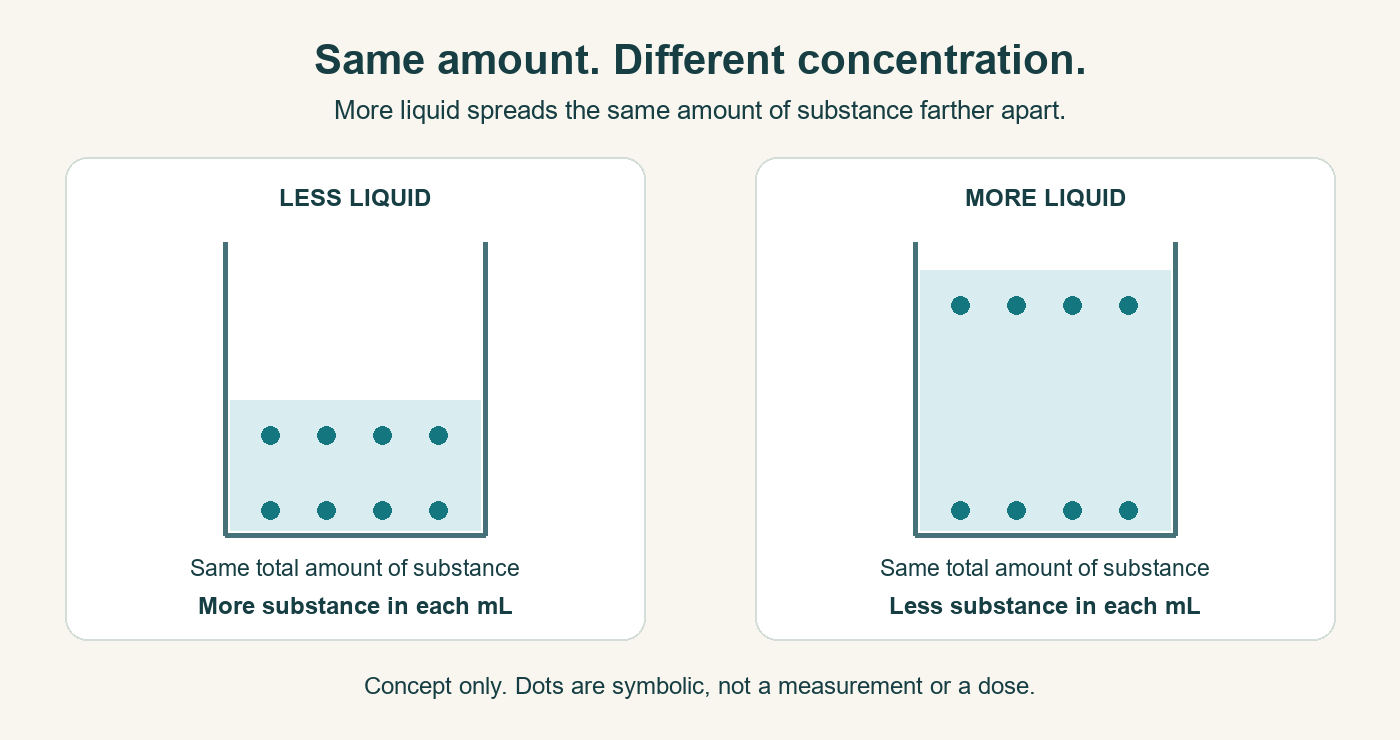
To understand the amount in a syringe, you need to know both the mixture’s concentration and the liquid volume drawn up. Copying someone else’s syringe marking can give a different amount if their mixture or syringe is different. The FDA has documented medication errors involving confusion between milligrams, milliliters and syringe units in compounded injectable semaglutide products. FDA dosing-error alert
What Liquid Should You Use to Reconstitute a Peptide?
Use the liquid identified in the instructions for the exact product and vial you received. You cannot identify the right liquid just by looking at the powder.
A liquid used to dissolve or dilute a product is called a diluent. Bacteriostatic water, often called BAC water, is one example. It contains benzyl alcohol, an ingredient that helps limit bacterial growth. That ingredient is called a preservative.
Sterile water without a preservative is a different product. The two cannot automatically be substituted for each other. Our BAC-water guide explains those differences in more detail.
Even when BAC water comes with a shipment, check that the written instructions identify it for that particular product. Some drugs should not be mixed with certain liquids or with benzyl alcohol. Hospira’s prescribing information directs users to the drug manufacturer’s instructions for the appropriate liquid and amount.
How Much BAC Water Should You Add?
“I know how much powder is in the vial, but how much water goes with it?”
The number on the peptide vial does not answer that question by itself. The instructions need to state the liquid amount. A larger container does not automatically need more water, and the vial should not simply be filled to the top.
Look for these details:
| Detail to find | What it should tell you |
|---|---|
| Product name and amount | Which product the instructions cover and how much is in the vial. |
| Mixing liquid | The exact liquid to use. |
| Liquid amount | How much to add, stated in milliliters (mL). |
| Final concentration | How much peptide will be in each milliliter after preparation. |
| Storage and discard instructions | Where to keep the prepared mixture and when to throw it away. |
A calculator can work with the numbers entered into it. It cannot check what is actually in a vial, choose the correct liquid or decide an appropriate dose.
If a detail is missing or the label and instructions disagree, have your pharmacist or prescriber check them against your actual vial and supplies before mixing.
Do Peptides Need Refrigeration Before Reconstitution?
Check the unopened product’s storage instructions when it arrives. Powder form alone does not tell you whether it belongs in a refrigerator, freezer or at room temperature.
Check the powder vial and the mixing liquid separately. They are different products and may need different storage conditions.
For example, Hospira’s bacteriostatic-water label specifies 20–25°C (68–77°F). That temperature applies to that water product. It does not tell you how to store a peptide mixed with it. Hospira prescribing information
If storage instructions are missing, get clarification instead of refrigerating or freezing the product “just in case.”
How Should You Store Peptides After Reconstitution?
After liquid has been added, follow the instructions for the mixed product. Instructions for the unopened powder may no longer apply.
You need to know:
- Whether the mixture can be kept for later use or must be used promptly.
- The required temperature.
- Whether it needs protection from light.
- Whether freezing is allowed.
- When it must be discarded.
Adding BAC water does not automatically make a mixture suitable for storage. Hospira’s label says prepared injectable drug solutions should not be stored unless the manufacturer of the drug allows it. Manufacturer’s storage precaution
How Long Do Reconstituted Peptides Last in the Fridge?
There is no single refrigerator shelf life for every peptide after mixing. Two separate questions matter:
| Question | Technical term |
|---|---|
| Does the peptide keep its expected strength and properties during storage? | Stability |
| Does the mixture remain free from germs that could contaminate it? | Sterility |
A mixture needs both. Putting an unknown product in the fridge does not tell you how long it will meet those conditions.
Does the 28-Day Rule Apply?
You may see advice online saying to discard a vial after 28 days. That needs context.
A multidose vial is a medication container labeled for repeated use. CDC guidance generally calls for dating it when first punctured and discarding it within 28 days unless the manufacturer specifies another period. It must not be kept past its original expiration date. This guidance does not establish a 28-day shelf life for every peptide mixed with BAC water. CDC guidance on multidose vials
Keep track of two separate events: when the BAC-water vial was first opened and when the peptide was mixed. Mixing does not reset the water’s history or create a new, universal expiration date for the peptide.
Can You Freeze Reconstituted Peptides?
Do not assume freezing will extend the life of a mixed peptide. Instructions to refrigerate do not also mean it is acceptable to freeze.
If a vial freezes accidentally or is left outside its required storage conditions, note how long this may have lasted and the approximate temperature. A pharmacist or manufacturer can use those details to assess the specific product. A general shelf-life chart cannot settle the question.
Thawing a vial and seeing a clear liquid does not prove that it is still suitable for use.
What If the Solution Looks Cloudy or Has Particles?
If a mixture that should be clear becomes cloudy, changes color or develops unexpected particles, do not use it while trying to work out what happened. Manufacturer labeling calls for checking prepared injectable solutions for unexpected particles and discoloration. Hospira prescribing information
Do not try to correct an unexpected appearance by adding more liquid or another ingredient. Have the pharmacist or manufacturer assess it.
A clear appearance does not prove that a vial is free from germs. CDC guidance calls for discarding medication vials when there is reason to doubt that the contents remain sterile. CDC injection-safety guidance
It can be frustrating to question a vial you paid for, especially when material remains. The amount left does not tell you whether it is still usable.
Still Unsure? Have These Details Ready
Keep the packaging and instructions together. If you need help understanding them, bring the vial label, mixing-liquid label and syringe packaging to the conversation. Also note whether the peptide is still dry or already mixed, when you mixed it and how it has been stored.
You can ask: “Can you check whether this product is appropriate for me and walk me through what these numbers and instructions mean?”
Understanding Your Vial Before Taking the Next Step
The amount in the whole vial, the amount of liquid added and the amount used at one time are different things. Knowing which number describes which amount makes the instructions easier to follow.
Use the instructions for the exact product you received, resolve missing or conflicting information, and check storage requirements before mixing. Our bacteriostatic-water guide explains the liquid in more detail and complements this introduction to peptide reconstitution.
Educational Notice
This guide provides general educational information. It does not establish that a research product is suitable for human use or determine an appropriate dose. It does not replace instructions for the exact product you received or guidance from a licensed healthcare professional. Mixing and storage information for one product may not apply to another.
Sources and Further Reading
- FDA: Dosing errors associated with compounded injectable semaglutide products
- Hospira: Bacteriostatic Water for Injection prescribing information
- CDC: Preventing Unsafe Injection Practices
- Taylor Tides: Bacteriostatic Water
Author: TaylorTides
Medical review status: Not reviewed by a licensed clinician
Research reviewed: September 26, 2026