
Educational Guide
MIC Injections
Ingredients, differences between MIC, MIC+B12 and Lipo-C, and what research says about weight loss, energy and safety.
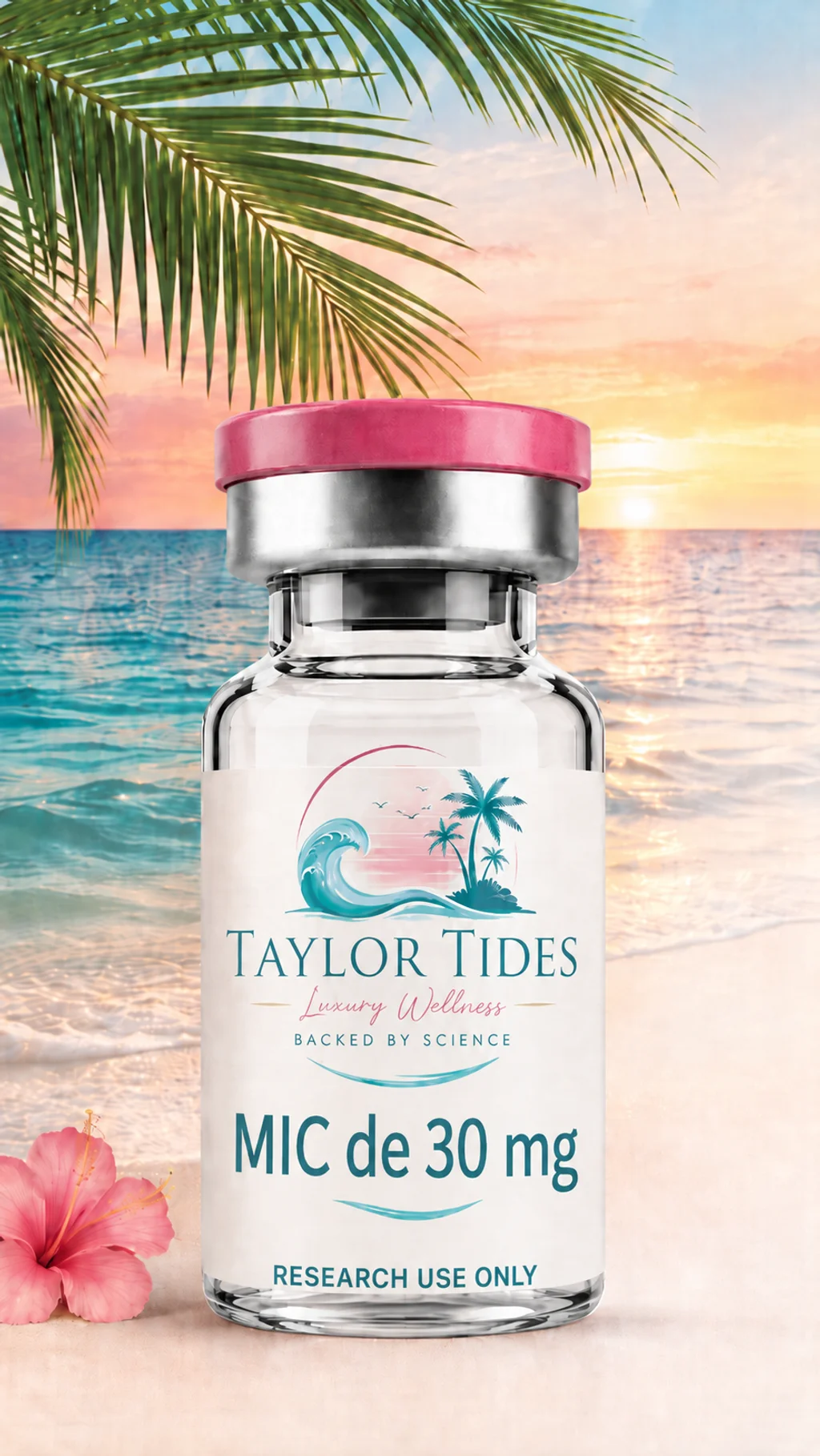
MIC injections combine methionine, inositol and choline, three substances involved in normal body functions. They are often promoted for weight loss and increased energy. Understanding what these ingredients do in the body is a starting point, but it does not establish what results injecting the blend will produce.
What are MIC injections?
The name MIC comes from the first letter of each ingredient. Each has a different role:
- Methionine: An amino acid, one of the building blocks the body uses to make proteins. You need to obtain it through your diet. PubChem
- Inositol: Participates in the signals that help cells respond to messages in the body. PubChem
- Choline: A nutrient the body uses to form the membranes surrounding cells, support nerve communication and help transport fats. NIH
MIC is a blend, not a peptide. A peptide consists of amino acids joined together in a chain. Mixing methionine with inositol and choline does not create that chain.
The name MIC identifies the three ingredients, but it does not indicate their amounts or whether anything else has been added. Check the complete label rather than assuming that all MIC products have the same formula.
MIC, MIC+B12 and Lipo-C: How do they differ?
These names may sound interchangeable, but they do not necessarily describe the same ingredients.
| Name | What it indicates | What to check |
|---|---|---|
| MIC | Methionine, inositol and choline | The amount of each ingredient and any added components |
| MIC+B12 | The three MIC ingredients with vitamin B12 added | The form and amount of B12, along with the complete ingredient list |
| Lipo-C | A name used for blends whose ingredients vary | Whether the formula contains inositol, B12, L-carnitine or other ingredients |
For example, Empower Pharmacy offers a Lipo-C formula containing methionine, choline, L-carnitine and dexpanthenol, a form of vitamin B5. Its ingredient list does not include inositol or B12. This describes one pharmacy’s product, not every product called Lipo-C. Empower Pharmacy formulation
Having more ingredients does not, by itself, demonstrate that a product offers greater benefits.
Our Lipo-C guide explains these differences in more detail.
Do MIC injections help with weight loss?
Research on MIC’s individual ingredients does not establish that MIC injections produce meaningful weight loss. An ingredient’s role in processing fats does not, by itself, tell us whether injecting a blend will reduce stored body fat.
For example, a review of 15 controlled trials found a small average reduction in body mass index, a measure relating weight to height, with oral inositol supplements. Results varied considerably between studies. Those findings concern inositol taken by mouth, not injections combining methionine, inositol and choline. Review of inositol supplementation
Personal weight-loss stories also need context. If someone starts using MIC while changing their diet, exercising or taking a weight-management medication, their results do not establish how much MIC contributed, if it contributed at all.
The ingredient research described here cannot predict how much weight you might lose with MIC injections or how quickly a change should occur.
Can MIC injections increase energy?
Some people report feeling more energetic after receiving MIC or MIC+B12 injections. Those experiences do not establish that MIC itself consistently improves energy, especially when the formula includes B12 or other added ingredients.
Vitamin B12 deserves a separate explanation. A deficiency can cause tiredness and weakness, and treating that deficiency may help. However, the U.S. National Institutes of Health explains that additional B12 does not improve energy or physical endurance in people who already have enough. NIH: Vitamin B12
This distinction matters when someone attributes an improvement to MIC+B12. Correcting a B12 deficiency would not demonstrate that methionine, inositol and choline provided an additional benefit.
Feeling tired also does not establish that you need a nutrient injection. If fatigue persists or begins after starting a medication, speak with your healthcare professional before adding another product. Understanding the cause is more useful than assuming that an “energy” blend will resolve it.
MIC injections: Side effects and safety questions
The name MIC is not enough to assess a product’s safety. The complete formula, ingredient amounts, how the product was made and your medical history all matter.
Several concerns should be considered separately:
- Reactions to ingredients. Review the complete list, including added vitamins and preservatives, with a clinician or pharmacist. Mention your allergies, medications, supplements and previous reactions.
- Contamination and infection. Unsafe preparation or administration can introduce bacteria or other organisms. These are general injection risks, not evidence that all MIC products are contaminated. CDC guidance on injection safety
- Product quality. If a product is compounded, it has not undergone the FDA approval process that evaluates its safety, effectiveness and quality. Incorrect ingredient amounts or contamination can cause serious harm. FDA: Risks of compounded drugs
Reports of symptoms online can identify concerns worth discussing, but they do not establish how often a reaction occurs or prove that MIC caused it. A list of side effects for one formula should not automatically be applied to every MIC blend.
Seek emergency help if you experience difficulty breathing, swelling of the tongue or throat, or collapse after an injection. These can be signs of a severe allergic reaction. Call 911 or your local emergency number. MedlinePlus: Anaphylaxis
What should you verify about a MIC product?
Before comparing products or considering an injection, get clear answers to these questions:
- What exactly does it contain? Request all ingredients and their amounts, including added vitamins and preservatives. Clarify whether a stated amount refers to each milliliter or the entire contents of the container.
- Who made it? Identify the manufacturer or dispensing pharmacy and whom you can contact with questions about the product.
- What evidence supports the proposed use? Ask whether the research studied that formula, administered by injection, for the result being discussed.
- What instructions apply to this product? Obtain its specific storage requirements and instructions on when to discard it, including any changes that apply after the container is first opened.
- Is it appropriate for you? Discuss your goal, medical history, medications and alternatives with a qualified healthcare professional. Ask how any benefit would be evaluated and which symptoms require medical attention.
If the label or instructions are unclear, resolve those questions with the dispensing pharmacy or prescribing clinician before using the product. Advice about someone else’s vial may not apply to yours.
MIC injections are easier to evaluate when you know the exact formula, the proposed purpose and the evidence supporting it. Those details provide a firmer basis for a decision than the product name or someone else’s results.
Educational notice
This article provides general information about MIC ingredients, research and safety considerations. It is not medical advice or a recommendation to use a particular product. Decisions about treatment, dosage, preparation and administration should be made with a qualified healthcare professional.
Research on an ingredient or another supplier’s formula does not establish the composition, quality, safety or effectiveness of a specific product. Product listings and references to suppliers should be evaluated separately from the educational information presented here.
Author: TaylorTides
Medical review status: Not reviewed by a licensed clinician.
Sources and further reading
- PubChem: Methionine
- PubChem: Inositol
- NIH: Choline
- NIH: Vitamin B12
- Inositol supplementation and body mass index: Systematic review and meta-analysis
- Empower Pharmacy: Lipo-C formulation. Cited for its listed ingredients, not as proof of effectiveness.
- CDC: Preventing unsafe injection practices
- FDA: Understanding the risks of compounded drugs
- MedlinePlus: Anaphylaxis